
Bladder Cancer Care
Bladder Cancer Treatment in Secunderabad — Bladder Preserved for Most, Robotic Surgery for All Stages
Blood in the urine (haematuria) is bladder cancer's most important early warning sign and the one that patients most commonly dismiss. It is often painless. It often comes and goes. And because it resolves on its own, many patients wait months before seeing a doctor. In that time, a potentially early and highly treatable cancer may progress. At KIMS Secunderabad, we take haematuria seriously from the first episode — not the third.
The good news is that most bladder cancers are diagnosed at an early stage. Approximately 80% of bladder cancers at diagnosis are non-muscle-invasive — meaning they have not grown into the muscle wall of the bladder. These cancers are treatable without removing the bladder, through a combination of endoscopic surgery (TURBT) and immunotherapy instilled directly into the bladder (BCG). For the 20% of patients with muscle-invasive disease, KIMS performs robotic radical cystectomy — with the option of neobladder reconstruction, creating a new bladder from a segment of bowel so that urine passes naturally.
If you have noticed blood in your urine — even once, even painlessly, even if it cleared up — you must have this investigated. Painless blood in the urine in someone over the age of 40 is bladder cancer until proven otherwise. Do not wait to see if it happens again. Call KIMS on 040 - 44885000 or book a cystoscopy assessment today.
At a glance
Condition
Bladder Cancer — most commonly Transitional Cell (Urothelial) Carcinoma
Most common symptom
Painless blood in urine (haematuria). Often intermittent. Does not go away on its own.
Two distinct types
NMIBC (Non-Muscle-Invasive) — 80% of cases. Bladder preserved. MIBC (Muscle-Invasive) — 20%. Bladder removal required.
Recurrence — important fact
Bladder cancer has the highest recurrence rate of any cancer — up to 70% for NMIBC. Structured surveillance cystoscopy is essential and provided at KIMS.
★ Most cases: bladder preserved
NMIBC treated with TURBT (endoscopic tumour removal, no incision) + BCG immunotherapy instilled into the bladder. Effective, bladder-sparing.
For muscle-invasive disease
Robotic Radical Cystectomy — removal of the bladder with robotic precision. Neobladder or ileal conduit reconstruction at KIMS.
Specialist at KIMS
Dr. Likhiteswer Pallagani — Vattikuti Foundation Fellowship in Uro-Oncology & Robotic Surgery (USA), 400+ robotic surgeries, robotic cystectomy with intracorporeal neobladder
Tumour board
Every bladder cancer case reviewed by the KIMS multidisciplinary tumour board before treatment
Appointments
040 - 44885000 · assistance@kimshospitals.com
What is bladder cancer?
Bladder cancer develops from the cells lining the inner surface of the bladder — the urothelium. The most common type, accounting for over 90% of bladder cancers, is transitional cell carcinoma (TCC), also called urothelial carcinoma. Less commonly, bladder cancer arises from squamous cells or glandular cells (adenocarcinoma). Bladder cancer is significantly more common in men than women, and the risk increases substantially with age over 50. Smoking is the single most significant preventable risk factor, accounting for approximately 50% of all bladder cancers.
The most critical determinant of treatment — and outcome — is whether the cancer has grown into the muscle wall of the bladder. This single question divides bladder cancer into two completely different clinical pathways with fundamentally different treatment approaches.
The two types of bladder cancer — the most important distinction
Which type do I have? The type of bladder cancer is determined by TURBT — the first procedure performed. The tissue removed during TURBT is sent to the pathologist, who examines the depth of invasion. The pathology report determines whether you have NMIBC or MIBC and guides all subsequent treatment decisions.
| Factor | Non-Muscle-Invasive (NMIBC) ★ | Muscle-Invasive (MIBC) |
|---|---|---|
| Prevalence | 80% of bladder cancers at diagnosis | 20% of bladder cancers at diagnosis |
| Pathology | Cancer confined to the inner lining — has NOT grown into the bladder muscle | Cancer has grown into or through the muscle wall of the bladder |
| Bladder Status | Bladder is preserved — not removed | Bladder must be removed (radical cystectomy) |
| Treatment | TURBT (endoscopic removal) + BCG or intravesical chemotherapy | Robotic radical cystectomy + urinary diversion (ileal conduit or neobladder) |
| Outlook | High cure rate with treatment and surveillance | Requires more extensive surgery — outcomes depend on stage |
| Recurrence | High recurrence rate (up to 70%) — surveillance cystoscopy every 3–6 months essential | Lower recurrence in the bladder after cystectomy — focus on systemic surveillance |
| 5-year survival | Ta/T1 low-grade 90%+ · T1 high-grade 70–80% with BCG | T2 (organ-confined) 60–70% · T3 40–50% · T4 <30% |
At KIMS Secunderabad, we specialize in Robotic Radical Cystectomy with Intracorporeal Neobladder reconstruction for patients with MIBC, allowing for better quality of life and natural voiding after surgery. Every case is reviewed by our multidisciplinary Tumour Board.
Symptoms — when to seek immediate investigation
Bladder cancer symptoms are dominated by urinary signs. The most important and most commonly missed:
Painless haematuria — blood in the urine without pain (most common symptom)
Painful haematuria — blood in urine with pain (requires urgent investigation)
Irritative urinary symptoms — frequency, urgency, and burning
Recurrent urinary tract infections — especially in older patients
Lower urinary tract obstruction — difficulty urinating or weak stream
Pelvic or bone pain — typically associated with advanced disease
Blood visible only once — even if it clears, it must be investigated
Microscopic blood — found on urine dipstick even if not visible to the eye
HAEMATURIA AT ANY AGE OVER 40 REQUIRES INVESTIGATION. Even if the blood is visible only once. Even if it is painless. Even if a urine dipstick shows only microscopic blood. The standard investigation is cystoscopy examination of the bladder with a thin telescope plus a CT urogram. Both are available at KIMS Secunderabad. Call 040 - 44885000.
How bladder cancer is diagnosed at KIMS
Diagnosis of bladder cancer requires direct visualisation of the bladder lining — the only way to definitively assess whether a tumour is present and where it is located. At KIMS, the diagnostic workup for haematuria is comprehensive and rapid.
Flexible Cystoscopy
A thin, flexible telescope is passed through the urethra into the bladder under local anaesthetic gel. The entire bladder lining is inspected in approximately 10 minutes. If a tumour is visible, the next step is TURBT.
CT Urogram
High-resolution CT scan of the entire urinary tract (kidneys, ureters, bladder) with contrast. This assesses the upper urinary tract for synchronous tumours and helps stage any visible bladder lesions.
Urine Cytology & Culture
Examination of shed urothelial cells for malignancy (crucial for CIS) and cultures to rule out UTI as a cause of haematuria before proceeding to invasive tests.
TURBT (Diagnostic & Therapeutic)
Transurethral Resection of Bladder Tumour is performed under anaesthesia. The tumour is resected using an endoscopic loop. This provides the critical pathology result that determines NMIBC vs MIBC.
Treatment — Non-Muscle-Invasive Bladder Cancer (NMIBC)
For approximately 80% of patients, bladder cancer is diagnosed at a non-muscle-invasive stage. The primary goal of treatment is to remove the tumor while preserving the bladder and preventing recurrence.
Step 1 — TURBT (Transurethral Resection of Bladder Tumour)
TURBT is the definitive initial treatment for all NMIBC. A resectoscope is passed through the urethra — no skin incision is made. An electrical loop removes the tumour and a margin of surrounding bladder wall muscle. The procedure takes 30 to 90 minutes under spinal or general anaesthesia. Most patients are discharged within 24 to 48 hours. The resected tissue is sent for histopathological analysis — the result determines the next steps. For high-grade T1 tumours where the pathology report suggests deep lamina propria invasion or concerns about muscle involvement, a "second-look" TURBT is performed 6 to 8 weeks after the first to ensure complete resection and confirm the absence of muscle invasion.
Step 2 — Intravesical therapy (medication into the bladder)
After TURBT, most NMIBC patients receive intravesical therapy — medication instilled directly into the bladder through a catheter, acting locally on the bladder lining: BCG (Bacillus Calmette-Guérin): The gold-standard treatment for intermediate and high-risk NMIBC. BCG is a live-attenuated bacterium that stimulates a local immune response to destroy remaining cancer cells. It is given as a weekly instillation for 6 weeks (induction), followed by maintenance instillations for up to 36 months. BCG significantly reduces recurrence rates from ~70% down to 35–40%. Intravesical chemotherapy (Mitomycin C): Often used for low and intermediate-risk NMIBC. A single instillation immediately after TURBT reduces early recurrence. For intermediate-risk tumours, a course of weekly instillations for 6–8 weeks may follow.
Step 3 — Surveillance cystoscopy — essential for life
Bladder cancer has the highest recurrence rate of any cancer; up to 70% of NMIBC patients develop recurrence within 5 years without ongoing surveillance. Regular visual inspection of the bladder via cystoscopy is not optional—it is the treatment that prevents a recurrence from becoming a more invasive cancer. Standard surveillance schedule at KIMS for high-risk NMIBC: • Cystoscopy at 3 months • Every 3 months for 2 years • Every 6 months for the next 2 years • Annually thereafter (lifelong) At KIMS, every NMIBC patient is enrolled in a structured surveillance programme from the day of their first TURBT.
Treatment — Muscle-Invasive Bladder Cancer (MIBC)
When bladder cancer invades the muscle wall, the risk of spread increases. At KIMS Secunderabad, we utilize a multimodal approach—combining medical oncology and advanced robotics—to ensure the highest chance of cure and the best possible quality of life post-surgery.
Neoadjuvant Chemotherapy (Before Surgery)
For most MIBC patients, cisplatin-based neoadjuvant chemotherapy (typically gemcitabine + cisplatin for 3–4 cycles) is recommended. Evidence from large clinical trials shows that chemotherapy given before surgery reduces the risk of metastatic relapse and improves long-term survival compared to surgery alone. At KIMS, neoadjuvant chemotherapy is coordinated by our expert medical oncology team within the same campus. This ensures a seamless transition as you proceed to the surgical phase of your treatment.
Robotic Radical Cystectomy (The Surgical Standard)
KIMS performs robotic radical cystectomy using the advanced Da Vinci Xi and X systems. Led by Dr. Likhiteswer Pallagani — a Vattikuti Foundation Fellow in Uro-Oncology trained in the USA — our robotic programme specializes in intracorporeal urinary reconstruction. The Procedure: Radical cystectomy removes the entire bladder, surrounding fat, pelvic lymph nodes, and associated organs (the prostate in men; the uterus and anterior vaginal wall in women if involved). The Robotic Advantage: The 3D magnified view allows for precise nerve-sparing dissection, preserving the nerves controlling continence and sexual function where safely possible. Patients experience significantly less blood loss and a faster recovery compared to traditional open surgery.
Urinary Reconstruction (Life After Cystectomy)
Once the bladder is removed, a new way for urine to leave the body must be created. At KIMS, we specialize in two primary reconstructive options: 1. Neobladder (Orthotopic Reconstruction): A new reservoir created from a bowel segment, connected to the urethra — urine passes naturally. Continence maintained with pelvic floor exercises. Best for patients with good urethral sphincter function, motivated for rehabilitation, no urethral margin involvement. 2. Ileal Conduit (Bricker Diversion): Bowel segment connects ureters to a stoma in the abdominal wall. Urine drains into a small skin-worn bag. Simpler management. Suitable for patients not suitable for neobladder, those preferring simplicity, or where the urethra is involved by tumour. Well-established and widely used.
| Urinary Diversion | Description & Suitability |
|---|---|
| Neobladder | Natural voiding, no external bag. Requires good sphincter function and rehabilitation. |
| Ileal Conduit | Urine drains to a stoma bag. Simpler management and recovery for most patients. |
Why choose KIMS Secunderabad for bladder cancer treatment?
Expertise of Dr. Likhiteswer Pallagani
Dr. Pallagani holds a prestigious Vattikuti Foundation Fellowship in Uro-Oncology and Robotic Surgery (USA). With over 400 robotic surgeries, he brings specific expertise in robotic radical cystectomy with intracorporeal neobladder and ileal conduit reconstruction to KIMS Secunderabad.
Multidisciplinary Tumour Board
Bladder cancer decisions at KIMS are never made by a single surgeon. Every case—from the first TURBT to radical cystectomy—is reviewed by a board including uro-oncologists, medical oncologists, radiation oncologists, and radiologists to create a personalized consensus recommendation.
Integrated Neoadjuvant Chemotherapy
For MIBC patients, evidence-based neoadjuvant chemotherapy is administered by our medical oncology team on the same 1,000-bed campus. Patients do not need to attend different hospitals; care is seamlessly coordinated within the same system before proceeding to surgery.
Advanced Robotic Surgical Systems
Using the Da Vinci Xi and X systems, we perform complex bladder removals and reconstructions entirely within the abdomen (intracorporeal). This robotic precision allows for better nerve-sparing, less blood loss, and faster recovery compared to traditional open surgery.
Structured Surveillance Programme — for Life
Our NMIBC programme is built around individual recurrence risk. With defined cystoscopy schedules and urine cytology monitoring, we contact patients before each appointment to ensure that recurrences are caught early and treated promptly.
Comprehensive Urinary Reconstruction
We specialize in orthotopic neobladder reconstruction, allowing eligible patients to maintain natural voiding without an external bag. For all patients, our dedicated stoma care and rehabilitation teams provide lifelong support for a high quality of life post-treatment.
Book a Bladder Cancer Consultation
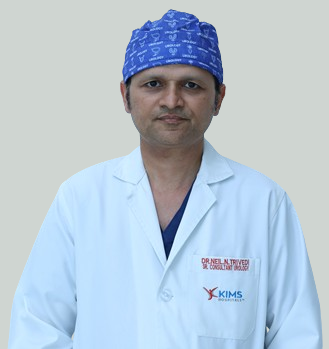
Our bladder cancer specialists at KIMS Secunderabad




Frequently Asked Questions
Possibly — and it must be investigated regardless of your age. Blood in the urine (haematuria) is the most common symptom of bladder cancer, present in approximately 85% of cases. Importantly, it is often painless. In a patient over 40, painless haematuria is bladder cancer until proven otherwise by cystoscopy. Even one visible episode, or microscopic blood found on a urine dipstick, warrants urgent investigation. At KIMS, we perform flexible cystoscopy — a 10-minute examination of the bladder with a thin telescope — to assess the bladder lining directly.
Not necessarily — and for most patients, the answer is no. Approximately 80% of bladder cancers at diagnosis are non-muscle-invasive (NMIBC), meaning the cancer is confined to the inner lining. These are treated with TURBT followed by BCG immunotherapy, and the bladder is completely preserved. Only the 20% of patients with muscle-invasive bladder cancer (MIBC) — where the tumour has grown into the muscle wall — require radical cystectomy (bladder removal). Your KIMS uro-oncologist will determine your type after pathology results.
TURBT (Transurethral Resection of Bladder Tumour) is the primary treatment for NMIBC. It is performed under spinal or general anaesthesia, so you are completely comfortable. A resectoscope is passed through the urethra into the bladder to remove the tumour. The procedure takes 30 to 90 minutes, and most patients are discharged within 24 to 48 hours. Some mild burning during urination for a few days after the procedure is normal and settles quickly.
BCG (Bacillus Calmette-Guérin) is a live-attenuated form of the tuberculosis bacterium instilled directly into the bladder via a catheter. It acts locally on the bladder lining to stimulate an immune response that destroys remaining cancer cells. BCG is the gold standard for intermediate and high-risk NMIBC, reducing recurrence rates from 70% to 35–40%. It is usually given as a 6-week induction course followed by maintenance over 3 years.
Yes — bladder cancer has the highest recurrence rate of any cancer. Up to 70% of NMIBC patients develop recurrence within 5 years without ongoing surveillance. This is why surveillance cystoscopy is a lifelong commitment. At KIMS, every patient is enrolled in a structured programme. A recurrence caught early during surveillance is usually treatable again with TURBT rather than requiring major surgery.
A neobladder is a new reservoir created from a bowel segment after the cancerous bladder is removed, connected so urine passes out naturally. With training, most patients achieve good continence without needing an external bag. Yes — neobladder reconstruction is available at KIMS Secunderabad. Dr. Likhiteswer Pallagani performs robotic radical cystectomy with intracorporeal neobladder construction — the most advanced technique available, performed entirely through keyhole ports.
Survival varies by stage. For low-grade NMIBC, 5-year survival is over 90%. For high-grade T1 NMIBC, it is 70–80% with proper treatment. For organ-confined muscle-invasive cancer (T2), it is 60–70% after radical cystectomy. These outcomes depend heavily on early diagnosis and adherence to treatment. At KIMS, the multidisciplinary tumour board reviews every case to plan the most effective individual treatment strategy.
KIMS Secunderabad provides the complete spectrum of care: flexible cystoscopy, TURBT, BCG therapy, and robotic radical cystectomy with neobladder reconstruction. Led by Dr. Likhiteswer Pallagani (Vattikuti Foundation Fellow), our team offers fellowship-trained expertise and multidisciplinary tumour board reviews. KIMS is NABH accredited and empanelled under Aarogyasri, CGHS, and EHS, ensuring accessible, high-quality uro-oncology care.