
Prostate Cancer Care
Prostate Cancer Treatment in Secunderabad — PSA Screening, Robotic Surgery, India's Only TULSA-PRO
If your PSA (Prostate Specific Antigen) blood test came back elevated — or if you have already been told following a biopsy that you have prostate cancer — you are facing a situation that thousands of men in India navigate every year. Prostate cancer is the most common male cancer in India. And when it is found early — through PSA testing before symptoms develop — it is one of the most treatable cancers in the human body. The 5-year survival rate for localised prostate cancer exceeds 95%.
At the KIMS Uro-Oncology Centre in Secunderabad, every prostate cancer case is reviewed by our multidisciplinary tumour board urological surgeon, medical oncologist, radiation oncologist, and radiologist before any treatment is recommended. For eligible patients, KIMS is India's first and only centre offering TULSA-PRO: MRI-guided, incision-free prostate treatment with no surgery, no radiation, and no general anaesthesia. For patients requiring surgery, our Da Vinci Xi and X robotic prostatectomy programme uses nerve-sparing techniques designed to preserve urinary continence and sexual function to the maximum extent possible.
At a glance
Condition
Prostate Cancer — Adenocarcinoma of the Prostate
Entry point for most patients
An elevated PSA (Prostate Specific Antigen) blood test — found during a routine check-up in an asymptomatic man.
Treatment depends on
Risk group (Low / Intermediate / High) — determined by PSA level, Gleason score (biopsy), and clinical stage (MRI).
For advanced disease
Hormone therapy (ADT) · Chemotherapy · Immunotherapy — coordinated with medical oncology on-site at KIMS
Multidisciplinary tumour board
Every case reviewed before treatment. No unilateral surgical decisions.
★ INDIA'S FIRST AND ONLY
TULSA-PRO (Transurethral Ultrasound Ablation) — MRI-guided, incision-free prostate cancer treatment. FDA-approved. Achieving 95% PSA reduction in clinical trials. Available at KIMS Secunderabad. No other hospital in India offers this.
For surgery
Robotic Radical Prostatectomy — Da Vinci Xi & X. Nerve-sparing technique preserves continence and sexual function to the maximum extent oncologically safe.
Insurance
All major private insurance
Appointments
040 - 44885000 · assistance@kimshospitals.com — respond within 24 hours
What is PSA and what does an elevated result mean?
PSA (Prostate Specific Antigen) is a protein produced by the prostate gland and detectable in the blood. A small amount of PSA in the blood is normal. Elevated PSA — typically above 4 ng/ml in most men, though age-adjusted thresholds are now used — can indicate prostate cancer, but it can also be elevated by benign conditions: BPH (enlarged prostate), prostatitis (prostate inflammation), or even vigorous exercise in the 48 hours before the test.
An elevated PSA does not diagnose prostate cancer — it identifies men who need further investigation. An MRI of the prostate (mpMRI — multiparametric MRI) is performed next, assessing for suspicious lesions and their location. If the MRI shows a suspicious area, a prostate biopsy — guided by the MRI images — confirms or excludes cancer, and provides the Gleason grade that determines the risk category and treatment pathway.
Men over 50 should discuss PSA testing with their doctor annually. Men with a family history of prostate cancer (father or brother affected) should start at 45. A normal PSA does not guarantee the absence of prostate cancer — but PSA screening significantly increases the chance of finding it at a curable stage.
What is prostate cancer?
Prostate cancer develops from the glandular cells of the prostate — most commonly in the peripheral zone (the outer part of the gland, furthest from the urethra). The vast majority are adenocarcinomas. Prostate cancer grows at very different rates in different men — some are so slow-growing that they never cause symptoms in a man's lifetime; others are aggressive and can spread rapidly to lymph nodes, bone, and other organs.
The Gleason score — assigned by the pathologist after prostate biopsy — is the most important indicator of prostate cancer behaviour. The Gleason score describes how abnormal the cancer cells look under the microscope, and therefore how aggressively the cancer is likely to grow. It is now reported as an ISUP grade group (1–5), which directly maps to the risk category that determines treatment.
Risk stratification — the decision that drives treatment
Before any treatment is discussed, your KIMS uro-oncology team places your prostate cancer into a risk category based on three pieces of information: your PSA level, your Gleason score (from biopsy), and your clinical T-stage (based on DRE and MRI).
| Risk Group | Definition | 5-year survival (localised) | KIMS treatment options |
|---|---|---|---|
| Low Risk (Gleason 6 / ISUP Grade 1) | PSA < 10 ng/ml AND Gleason 6 (3+3) AND T1–T2a | 95%+ — Unlikely to cause problems in lifetime without treatment | Active surveillance · TULSA-PRO (focal ablation) · Robotic radical prostatectomy · Radiation therapy |
| Intermediate Risk (Gleason 7 / ISUP Grade 2–3) | PSA 10–20 ng/ml OR Gleason 7 (3+4 or 4+3) OR T2b–T2c | 85–90% with treatment | TULSA-PRO (whole gland) for suitable patients · Robotic radical prostatectomy · Radiation + hormone therapy |
| High Risk (Gleason 8–10 / ISUP Grade 4–5) | PSA > 20 ng/ml OR Gleason 8–10 OR T3–T4 | 60–75% with combined modality treatment | Robotic radical prostatectomy + pelvic lymph node dissection · Radiation + long-course hormone therapy · Neoadjuvant hormone therapy before surgery |
| Metastatic / Advanced | Cancer spread to lymph nodes, bone, or other organs | Varies — modern systemic therapy significantly improves survival | Hormone therapy (ADT) · Chemotherapy (docetaxel) · Novel antiandrogens · PARP inhibitors · Coordinated with KIMS medical oncology |
Treatment options at KIMS — matched to your risk group
Prostate cancer treatment is not one-size-fits-all. At KIMS, we provide the full spectrum of care, from active monitoring for low-risk disease to the most advanced robotic and incision-free technologies in India. Every treatment plan is tailored to the individual’s risk category, age, and personal goals.
Option 1 — Active Surveillance — for low-risk prostate cancer
For low-risk prostate cancer (Gleason 6 / ISUP Grade 1), immediate treatment is not always necessary. Active surveillance involves monitoring the cancer with regular PSA tests (every 6 months), prostate MRI (annually), and repeat biopsy (at 12 months, then every 2–3 years) — intervening with treatment only if the cancer shows signs of progression. Many men with low-risk prostate cancer live their entire lives without the cancer ever needing treatment. Active surveillance is not the same as ignoring the cancer. It is a structured programme with defined triggers for intervention — and it avoids the side effects of unnecessary treatment in men whose cancer would never cause them harm. At KIMS, every active surveillance patient is enrolled in a documented protocol with their own defined review schedule.
Option 2 — TULSA-PRO — India's First and Only Centre ★
KIMS Secunderabad is the first and only hospital in India offering TULSA-PRO (Transurethral Ultrasound Ablation) — MRI-guided, incision-free prostate cancer treatment. FDA-approved. In the pivotal clinical trial of 115 patients, TULSA-PRO achieved an average 95% PSA reduction to a threshold of 0.34 ng/ml. No other hospital in India can offer this treatment. TULSA-PRO delivers precisely controlled ultrasound energy through a slender device passed through the urethra — the natural urinary passage — into the prostate. No incision is made on the body. The entire procedure takes place inside an MRI scanner, with the surgeon using real-time MRI imaging to see exactly which prostate tissue is being ablated and to actively protect the surrounding sphincter, nerves, and rectum throughout. Key Benefits: • Approach: Device passed through urethra — no skin incision, no open wound • Guidance: Real-time MRI — surgeon sees every millimetre being treated • Recovery: Most patients resume normal activity within 2–5 days • Function: Significantly better preservation of continence and sexual function than surgery or radiation.
Option 3 — Robotic Radical Prostatectomy — Da Vinci Xi & X
Robotic radical prostatectomy — complete removal of the prostate gland through keyhole surgery using Da Vinci robotic systems — is the definitive surgical treatment for localised and locally advanced prostate cancer. KIMS operates both Da Vinci Xi and X, the most advanced platforms available. The principal advantage of robotic over open prostatectomy is precision in the most anatomically challenging part of the surgery: the dissection of the neurovascular bundles — the nerve networks running alongside the prostate that control urinary continence and erectile function. The 10x magnified 3D robotic view allows KIMS surgeons to perform nerve-sparing prostatectomy with a degree of precision that consistently exceeds what is achievable in open surgery. KIMS Specifics: • System: Da Vinci Xi and X — most advanced platforms • Incision: 3–5 small keyhole ports — no large abdominal scar • Hospital Stay: 1–2 nights • Target: PSA at 6 weeks post-operatively should be undetectable (<0.1 ng/ml).
Option 4 — Radiation therapy — for localised and locally advanced prostate cancer
External beam radiotherapy (EBRT) — using IMRT (Intensity Modulated Radiation Therapy) or VMAT techniques — delivers high-energy radiation to the prostate from multiple angles, precisely shaped to minimise dose to the rectum and bladder. For intermediate and high-risk prostate cancer, radiotherapy is combined with hormone therapy (androgen deprivation therapy — ADT) to improve outcomes. At KIMS, radiation therapy is coordinated by the radiation oncology team within the same 1,000-bed campus. Radiotherapy is an alternative to surgery for localised prostate cancer, with equivalent cure rates for most risk groups.
Option 5 — Hormone Therapy (Androgen Deprivation Therapy — ADT)
Prostate cancer cells depend on testosterone to grow. ADT (hormone therapy) reduces testosterone to near-zero levels, depriving cancer cells of the signal they need to divide. ADT is used in combination with radiation therapy for intermediate and high-risk prostate cancer, before or after surgery for high-risk disease, and as the primary treatment for metastatic prostate cancer. Modern long-acting ADT injections (leuprolide, goserelin, degarelix) are administered every 1–6 months. Side effects include hot flushes, fatigue, and reduced libido — managed with lifestyle modification, exercise, and bone-protective agents at KIMS.
Advanced Care — For advanced and metastatic prostate cancer
Prostate cancer that has spread to lymph nodes, bone, or distant organs is managed with systemic therapy coordinated between the uro-oncology surgical team and the medical oncology department at KIMS. Current standard treatments include: • mHSPC: ADT combined with enzalutamide, abiraterone acetate, or docetaxel chemotherapy. • mCRPC: Novel antiandrogens, PARP inhibitors (for BRCA1/2-mutated tumours), and Lutetium-177-PSMA radioligand therapy. The KIMS tumour board reviews every advanced prostate cancer case to plan the most appropriate combination approach.
Why choose KIMS Secunderabad for prostate cancer treatment?
KIMS Secunderabad provides the most advanced prostate cancer care in the country, combining exclusive incision-free technology with a world-class robotic surgery programme and a multidisciplinary team approach.
India's first and only TULSA-PRO centre
KIMS Secunderabad is the world's most advanced incision-free prostate cancer treatment centre. This is a national exclusive; no other hospital in India offers TULSA-PRO. For men who want effective treatment without surgery, radiation, or the sexual function side effects of conventional procedures, KIMS is the only option in the country.
Da Vinci Xi AND X — both platforms
KIMS operates both the Da Vinci Xi and Da Vinci X — the two most advanced systems in the Da Vinci range. The Xi platform's multi-quadrant capability is specifically advantageous for complex cases, extended lymph node dissection, and any case requiring multi-quadrant dissection in the pelvis.
Every case reviewed by the multidisciplinary tumour board
No prostate cancer treatment decision at KIMS is made by a single surgeon. Every case—from active surveillance entry to advanced disease systemic therapy—is reviewed by the full tumour board. Our recommendation represents the consensus of the urological surgeon, radiation oncologist, medical oncologist, and radiologist.
Radiation oncology and medical oncology on the same campus
For patients requiring combined modality treatment — such as surgery followed by radiation or hormone therapy (ADT) — every specialist is available within the same 1,000-bed KIMS campus. No patient needs to travel to a different hospital for any component of their prostate cancer treatment.
Honest discussion of continence and sexual function
At KIMS, functional outcomes are part of every pre-treatment consultation, not a footnote. TULSA-PRO offers the best functional outcome profile available today, and our robotic nerve-sparing prostatectomy is performed with preservation as a primary goal. Every patient knows what to expect before any procedure is scheduled.
Advanced imaging and precision diagnostics
Accurate treatment starts with accurate staging. We utilise high-resolution multiparametric MRI (mpMRI) and PSMA-PET scans to precisely locate cancer before treatment, ensuring that our surgeons and oncologists can target the disease while sparing as much healthy tissue as possible.
Start Kidney Failure Care at KIMS
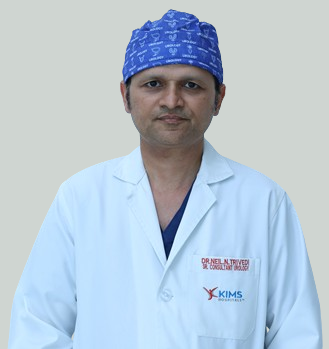
Our prostate cancer specialists at KIMS Secunderabad




Frequently Asked Questions
Not necessarily. An elevated PSA can be caused by prostate cancer — but also by benign conditions including enlarged prostate (BPH), prostatitis (prostate infection or inflammation), and even vigorous exercise in the 48 hours before the test. A PSA above 4 ng/ml in men aged 50–70, or above 3 ng/ml in men with a family history, warrants further investigation. The next step is typically a prostate MRI (mpMRI) to look for suspicious areas — if found, a targeted prostate biopsy is performed. A raised PSA alone is not a diagnosis of prostate cancer. It is a signal that further investigation is needed. Book a PSA consultation at KIMS on 040 - 44885000.
Yes — when caught early, prostate cancer is one of the most curable cancers. Low-risk localised prostate cancer (Gleason 6, confined to the prostate) has a 5-year survival rate exceeding 95% with treatment — or even with active surveillance alone in many cases. Intermediate-risk localised disease (Gleason 7) has an 85–90% 5-year survival with robotic prostatectomy or radiation. High-risk localised disease has a 60–75% 5-year survival with combined modality treatment. The single most important determinant of curability is stage at diagnosis — which is why PSA screening, even in asymptomatic men, is so valuable.
TULSA-PRO (Transurethral Ultrasound Ablation) is an MRI-guided treatment for prostate cancer and BPH that destroys prostate tissue using focused ultrasound energy delivered through a device passed through the urethra — with no incision, no surgical wound, and no radiation. Real-time MRI guidance allows the surgeon to see exactly what is being treated and to actively protect the surrounding nerves, urinary sphincter, and rectum. In the pivotal clinical trial of 115 patients, TULSA-PRO achieved an average 95% PSA reduction to a low threshold of 0.34 ng/ml. Yes — TULSA-PRO is available in India. KIMS Secunderabad is India's first and only TULSA-PRO centre. No other hospital anywhere in India offers this treatment.
These are the concerns every man with prostate cancer has but may not ask directly. With robotic nerve-sparing radical prostatectomy at KIMS: urinary continence is recovered by the majority of men within weeks to months after catheter removal — pelvic floor exercises started immediately post-operatively significantly speed recovery. Erectile function recovery depends on age, pre-operative function, and how much nerve sparing was achievable — younger men and those with fully preserved pre-operative function have the best outcomes. TULSA-PRO has significantly better functional preservation than either surgery or radiation — because the sphincter and nerve bundles are actively protected with MRI guidance in real time. Your KIMS uro-oncologist will discuss individual expectations honestly at your consultation.
The Gleason score is the pathologist's assessment of how aggressive your prostate cancer cells look under the microscope. It is now reported as an ISUP grade group from 1 to 5. Grade Group 1 (Gleason 6): low-risk — slow-growing, excellent prognosis, active surveillance may be appropriate. Grade Group 2–3 (Gleason 7): intermediate-risk — treatment is recommended. Grade Group 4–5 (Gleason 8–10): high-risk or very high-risk — more aggressive treatment is usually indicated, often combining surgery with hormone therapy, or radiation with long-course hormone therapy. Your Gleason score is the single most important determinant of how urgently and how aggressively your prostate cancer needs treatment.
Active surveillance means monitoring low-risk prostate cancer closely with regular PSA tests (every 6 months), MRI scans (annually), and repeat biopsy (at 12 months, then every 2–3 years) — without giving any immediate treatment — and only intervening if the cancer shows signs of progression. It is appropriate for men with low-risk (Gleason 6 / ISUP Grade 1) prostate cancer who have a low-volume tumour. The rationale: many Gleason 6 prostate cancers grow so slowly that they never cause problems in a man's lifetime. Active surveillance avoids the side effects of unnecessary surgery or radiation in these men, without compromising their chance of cure. At KIMS, active surveillance patients are enrolled in a documented protocol with defined review triggers.
Robotic radical prostatectomy at KIMS Secunderabad costs approximately ₹6,50,000 to ₹7,00,000, inclusive of the surgical procedure, anaesthesia, Da Vinci robotic system use, and standard post-operative hospital stay. TULSA-PRO pricing is available directly from the KIMS billing team — contact 040 - 44885000. KIMS accepts all major private insurance plans. The billing team will verify your specific coverage before any procedure is scheduled.
KIMS Secunderabad is India's first and only TULSA-PRO centre — offering the world's most advanced incision-free prostate cancer treatment, available nowhere else in India. For patients requiring surgery, KIMS operates both Da Vinci Xi and X robotic systems for nerve-sparing radical prostatectomy with the best possible functional outcomes. Every case is reviewed by the multidisciplinary tumour board. Radiation oncology and medical oncology are available for combined modality treatment within the same 1,000-bed campus. KIMS is NABH accredited, Times Healthcare Nephrology Award winner, and empanelled under Aarogyasri, CGHS, and EHS.