
Robotic Urology Surgery at KIMS Secunderabad — Da Vinci Xi & X, Vattikuti-Trained Surgeons
At a glance — KIMS Robotic Surgery Programme
- Robotic systems: Da Vinci Xi (latest generation) AND Da Vinci X — both in active use
- Surgeon credential: Dr. Likhiteswer Pallagani — Vattikuti Foundation Fellow, Uro-Oncology & Robotic Surgery (USA). Vattikuti Foundation training at Henry Ford Hospital, Detroit is the highest-recognised robotic urology fellowship in India.
- Robotic procedure volume: 400+ robotic urological surgeries performed by KIMS uro-oncology team
- Procedures performed: Robotic Radical Prostatectomy (RARP) · Robotic Partial Nephrectomy (RAPN) · Robotic Radical Nephrectomy (RARN) · Robotic Radical Cystectomy (RARC) · Robotic Pyeloplasty
- Tumour board review: Every cancer case reviewed by the multidisciplinary tumour board before robotic surgery is scheduled — urology, oncology, radiology, pathology
- Xi advantage over X: Da Vinci Xi — extended reach and fourth arm capability for multi-quadrant procedures. AINU Secunderabad operates only Da Vinci X.
- Appointments: 040 - 44885000 · assistance@kimshospitals.com
What is robotic surgery and why does the platform matter?
Robotic surgery does not mean a robot operates independently. A da Vinci robotic surgical system is a sophisticated set of instruments controlled entirely by the surgeon — who sits at a console a few metres from the operating table, viewing a 10x magnified, three-dimensional image of the operative field and translating hand, wrist, and finger movements into precise instrument movements inside the patient's body. The robotic arms filter out natural hand tremor, move in seven degrees of freedom (more than a human wrist), and can operate in anatomical spaces — the deep pelvis, the renal hilum — that are difficult or impossible to access with conventional laparoscopic instruments.
For urological surgery — where the prostate, kidney, and bladder sit deep in the pelvis or retroperitoneum, surrounded by critical nerves and blood vessels — the precision advantage of robotic surgery over open and conventional laparoscopic surgery translates directly into better functional outcomes: better preservation of urinary continence and erectile function after prostatectomy, more kidney tissue preserved during partial nephrectomy, reduced blood loss in all procedures.
KIMS Secunderabad operates both Da Vinci Xi and Da Vinci X — the two most advanced platforms in the da Vinci range. AINU Secunderabad, the nearest robotic surgery competitor, operates Da Vinci X only. The Xi platform's extended reach, fourth arm capability, and superior multi-quadrant dexterity make it the preferred system for complex radical cystectomy, extensive lymph node dissection, and any procedure requiring instrument access across multiple abdominal quadrants.
The KIMS robotic surgery team — Vattikuti Foundation trained
Robotic surgery outcomes are not determined by the robot — they are determined by the surgeon's training, volume, and technical refinement. A Da Vinci system operated by a surgeon who has performed 20 cases produces very different results from one operated by a surgeon who has performed 400.
Dr. Likhiteswer Pallagani — Vattikuti Foundation Fellow, Uro-Oncology & Robotic Surgery (USA). The Vattikuti Foundation Fellowship in Uro-Oncology and Robotic Surgery, conducted at Henry Ford Hospital in Detroit, is the most recognised and competitive robotic urology fellowship for Indian surgeons. Vattikuti Fellows spend 12 to 18 months training under world-leading robotic urologists in the USA, returning with both the technical skills and the quality metrics to perform robotic surgery at an internationally benchmarked standard. Dr. Pallagani has performed over 400 robotic urological surgeries at KIMS Secunderabad — bringing this international training to patients in Hyderabad at a fraction of the cost of equivalent surgery in the USA or Singapore.
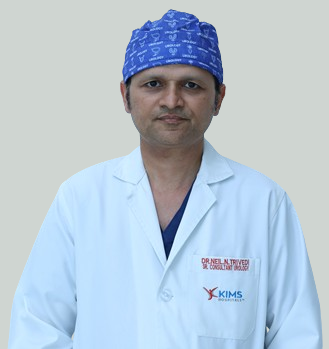
Dr. K. V. R. Prasad, Dr. Neil Narendra Trivedi, Dr. Y. M. Prashanth — experienced uro-oncology team. KIMS's robotic surgery programme is not dependent on a single surgeon. Every robotic case is planned and reviewed by the full uro-oncology team, and multiple experienced urological surgeons work alongside the primary robotic operator.
Robotic urological procedures at KIMS
1 — Robotic Radical Prostatectomy (RARP) — for prostate cancer
Robotic radical prostatectomy is the removal of the entire prostate gland, seminal vesicles, and (where indicated) pelvic lymph nodes for localised or locally advanced prostate cancer. The keyhole approach — five or six small ports in the lower abdomen — gives the Da Vinci system access to the deep pelvis where the prostate sits. The 10x magnified 3D view allows the KIMS surgeon to identify and precisely dissect the neurovascular bundles — the nerve networks running alongside the prostate that control urinary continence and erectile function — with a degree of accuracy impossible in open surgery.
| RARP at KIMS | Detail |
|---|---|
| Indications | Localised prostate cancer (cT1–T2) · Selected locally advanced (cT3) after multidisciplinary tumour board review |
| Nerve-sparing technique | Bilateral or unilateral, based on tumour location and Gleason grade — decided pre-operatively and discussed with the patient |
| Blood loss | Typically under 200 ml — transfusion rarely required |
| Hospital stay | 1–2 nights |
| Catheter duration | 7–10 days |
| Continence recovery | Most patients regain continence within weeks to months — pelvic floor exercises from day 1 |
| PSA follow-up | At 6 weeks post-operatively — target: undetectable (<0.1 ng/ml) |
| Cost at KIMS | ₹6,50,000–₹7,00,000 (sourced from KIMS main site — verify current with billing) |
2 — Robotic Partial Nephrectomy (RAPN) — kidney-sparing cancer surgery
Robotic partial nephrectomy removes a kidney tumour while preserving the surrounding healthy kidney tissue — the standard of care for renal tumours up to 7cm in a normally functioning kidney, and increasingly offered for larger tumours where kidney function preservation is a priority for kidney cancer treatment. The Da Vinci system's precision allows the KIMS surgeon to excise the tumour with adequate margins, reconstruct the collecting system if entered, and close the renal parenchyma — all under the time pressure of warm ischaemia (the renal artery is clamped during the resection to minimise blood loss). Robotic partial nephrectomy at experienced centres achieves equivalent oncological outcomes to radical nephrectomy for appropriate-sized tumours, with the major advantage of preserved kidney function — critical for patients with a solitary kidney, bilateral tumours, or pre-existing CKD.
| RAPN at KIMS | Detail |
|---|---|
| Indications | Renal tumour ≤7 cm (T1a, T1b) in a normally functioning contralateral kidney · Imperative indications: solitary kidney, bilateral tumours, CKD |
| Warm ischaemia time target | Under 20–25 minutes — KIMS robotic partial nephrectomy aims for the shortest clamp time compatible with safe resection |
| Blood loss | Typically 100–300 ml |
| Hospital stay | 2–3 nights |
| Return to activity | Desk work: 2–3 weeks · Physical work: 4–6 weeks |
| Kidney function | Most patients lose <10% of overall kidney function with RAPN vs 30–40% loss with radical nephrectomy |
3 — Robotic Radical Nephrectomy (RARN) — for larger or complex renal tumours
When a kidney tumour is too large or too centrally located for kidney-sparing surgery, or when the contralateral kidney is entirely normal, robotic radical nephrectomy — complete removal of the affected kidney — is performed. The robotic approach converts what was historically a large flank incision operation into a keyhole procedure, with dramatically reduced blood loss, shorter hospital stay (2 to 3 nights versus 5 to 7 days for open surgery), and faster return to activity. For tumours with renal vein or inferior vena cava thrombus — IVC tumour thrombectomy — KIMS plans these cases through the multidisciplinary team and, where robotic access is appropriate, performs the thrombectomy robotically.
4 — Robotic Radical Cystectomy (RARC) — for muscle-invasive bladder cancer
Radical cystectomy — removal of the entire bladder, prostate (in men), and surrounding lymph nodes — is the definitive treatment for muscle-invasive bladder cancer (MIBC). This is one of the most technically demanding procedures in urology. The robotic approach, using the Da Vinci Xi's extended reach and fourth arm capability, allows the KIMS team to perform the entire resection and lymph node dissection robotically, with reconstruction (neobladder or ileal conduit) performed either robotically or through a small assisted extraction incision. Compared to open radical cystectomy, the robotic approach significantly reduces intraoperative blood loss, shortens the hospital stay, and accelerates return to normal function — critical for patients who may be offered adjuvant chemotherapy and need to recover quickly enough to receive it.
Neobladder reconstruction — where a section of small bowel is fashioned into a new bladder reservoir and connected to the urethra — allows some patients to void naturally after radical cystectomy. KIMS discusses neobladder eligibility (based on tumour location relative to the urethral sphincter, and patient fitness) at the pre-operative planning stage. See our Bladder Cancer condition page for the full neobladder vs ileal conduit comparison.
5 — Robotic Pyeloplasty — for UPJ obstruction
Ureteropelvic junction (UPJ) obstruction is a narrowing at the junction between the renal pelvis and ureter, causing impaired drainage of urine from the kidney — leading to hydronephrosis, flank pain, and recurrent kidney infections. Robotic pyeloplasty dismembers the obstructed segment and reconstructs the renal pelvis-ureter junction over a temporary ureteral stent. The robotic approach allows the KIMS surgeon to perform the delicate suturing required for a watertight anastomosis with precision and speed that exceeds conventional laparoscopic pyeloplasty. Success rates for robotic pyeloplasty exceed 95% at experienced centres. Hospital stay is 2 to 3 nights; the DJ stent is removed 4 to 6 weeks post-operatively.
Robotic vs open vs conventional laparoscopic — why the choice matters
| Feature | Robotic (Da Vinci) | Conventional Laparoscopic | Open Surgery |
|---|---|---|---|
| Vision | 10x magnified 3D HD — nerve structures clearly visible | 2D or basic 3D, limited magnification | Direct vision, no magnification in pelvis |
| Instrument movement | 7 degrees of freedom — wrist-like movement inside body | 4 degrees, no wrist at instrument tip | Unrestricted but limited by incision depth |
| Hand tremor | Filtered out — sub-millimetre precision | Not filtered, tremor transmitted | Not filtered, less critical in open field |
| Incisions | 5–6 small ports (0.5–1.2cm) | Same | Single large incision (10–20cm) |
| Blood loss | Lowest | Low | Highest |
| Hospital stay | 1–3 nights | 2–4 nights | 4–7 nights |
| Return to work | 2–4 weeks | 3–5 weeks | 6–8 weeks |
| Nerve-sparing precision | Highest — 3D magnification, no tremor, wristed instruments | Moderate | Variable |
| Best indication | Prostatectomy, partial nephrectomy, cystectomy, pyeloplasty | Simpler procedures | Very large tumours, IVC thrombus, salvage cases |
Why choose KIMS for robotic urological surgery?
Da Vinci Xi AND X — both latest platforms
AINU Secunderabad operates Da Vinci X only. KIMS operates both Xi and X. The Xi platform, with its extended arm reach and fourth arm, is specifically superior for radical cystectomy (requiring multi-quadrant access across the pelvis and abdomen), extended pelvic lymph node dissection, and any complex case where instrument reach across multiple quadrants is required. Having both systems means KIMS can match the optimal platform to each individual procedure.
Vattikuti Foundation Fellowship training — the highest standard
The Vattikuti Foundation Fellowship at Henry Ford Hospital, Detroit trains Indian urologists to the same technical standard as the USA's best robotic centres. Dr. Pallagani's 400+ robotic procedures at KIMS represent the accumulated refinement of that training in the Secunderabad context — knowing the specific anatomy, comorbidities, and post-operative support system of this patient population.
Multidisciplinary tumour board review — no unilateral decisions
Every cancer patient at KIMS has their case reviewed by the uro-oncologist, medical oncologist, radiation oncologist, and radiologist before a robotic surgery date is set. This ensures the patient isn't offered surgery when chemotherapy or radiation would be more appropriate — and that the surgical plan is optimised before the patient reaches the operating room.
Nephrology integration for kidney function monitoring post-nephrectomy
After robotic partial nephrectomy, the remaining kidney must be monitored for function change — particularly in patients with pre-existing CKD or a solitary kidney. After radical nephrectomy, the contralateral kidney compensates but eGFR falls permanently by 30–40%. KIMS nephrologists monitor kidney function after all renal surgery, initiating protective measures where needed.
Our robotic surgery team at KIMS Secunderabad




FAQ SECTION
Robotic surgery offers specific advantages over conventional laparoscopic and open surgery for complex urological procedures — it is not universally 'safer' for all operations, but it is demonstrably superior for the procedures where it is most used (prostatectomy, partial nephrectomy, radical cystectomy). The advantages are: 10x magnification in 3D for identifying critical nerve and vessel structures that are 1–2mm in diameter; tremor-filtered instrument movement for millimetre-precision dissection; seven degrees of freedom that exceed what conventional laparoscopic instruments can achieve in the deep pelvis; and consistently lower blood loss and transfusion rates. For prostatectomy specifically, robotic surgery is associated with better continence and erectile function preservation than either open or laparoscopic approaches at high-volume centres.
KIMS Secunderabad operates both the Da Vinci Xi and Da Vinci X — the two most advanced platforms currently in the da Vinci range. Both are the latest generation of da Vinci technology, featuring HD 3D vision, full EndoWrist instrument capability, and the complete range of robotic instruments. The Xi additionally has a multi-quadrant arm configuration and extended reach that makes it the preferred platform for radical cystectomy and complex pelvic procedures. AINU Secunderabad, the nearest robotic surgery competitor, operates Da Vinci X only.
Dr. Likhiteswer Pallagani is KIMS's primary robotic urological surgeon — a Vattikuti Foundation Fellow in Uro-Oncology and Robotic Surgery who trained at Henry Ford Hospital, Detroit, USA. The Vattikuti Foundation Fellowship is the most competitive and internationally recognised robotic urology training programme for Indian surgeons. Dr. Pallagani has performed over 400 robotic urological surgeries at KIMS. He is supported by Drs. KVR Prasad, Neil Trivedi, and YM Prashanth — all experienced uro-oncology urologists contributing to the team's robotic programme.
Blood transfusion during robotic urological surgery is uncommon. The pneumoperitoneum (gas pressure maintained in the abdomen during robotic surgery) reduces venous bleeding, and the precision of robotic instrument dissection — particularly the Da Vinci Xi's wrist-like movement — allows blood vessels to be identified and sealed before division rather than controlled under pressure. Blood loss during robotic prostatectomy is typically under 200 ml; during robotic partial nephrectomy under 300 ml. Patients with low pre-operative haemoglobin are optimised before surgery. KIMS maintains blood cross-matching for all robotic procedures as standard preparation.
Hospital stay depends on the specific procedure. Robotic prostatectomy (RARP): 1 to 2 nights — the patient goes home with a urinary catheter in place, which is removed at a clinic appointment 7 to 10 days later. Robotic partial nephrectomy (RAPN): 2 to 3 nights — a drain is left in place for the first 24 to 48 hours. Robotic radical cystectomy (RARC): 4 to 7 nights — this is the longest recovery because of the urinary diversion reconstruction (neobladder or ileal conduit). Robotic pyeloplasty: 2 to 3 nights — the DJ stent remains in place for 4 to 6 weeks. All patients walk on the day of surgery or the following morning — early mobilisation is a priority in all KIMS robotic surgery protocols.
Yes — robotic surgery is the standard approach for kidney cancer at KIMS, for both organ-sparing and radical procedures. Robotic partial nephrectomy (RAPN) is used for kidney tumours up to 7cm, preserving the maximum healthy kidney tissue — critically important for patients who have only one functioning kidney, pre-existing CKD, or bilateral tumours. Robotic radical nephrectomy (RARN) is used for larger tumours or when a kidney-sparing approach is not anatomically feasible. The robotic approach eliminates the large flank incision of open nephrectomy, reducing pain, hospital stay (2 to 3 nights vs 5 to 7 days open), and recovery time (return to work 3 to 4 weeks vs 6 to 8 weeks open).
Robotic radical prostatectomy at KIMS costs approximately ₹6,50,000 to ₹7,00,000 (inclusive of surgery, anaesthesia, and standard hospital stay — sourced from KIMS main site). Costs for robotic partial nephrectomy, radical cystectomy, and pyeloplasty vary based on procedure complexity, duration, and post-operative stay. Contact the KIMS billing team on 040 - 44885000 for a personalised cost estimate for your specific procedure. KIMS accepts all major private health insurance plans — the billing team will verify your coverage and provide a pre-authorisation estimate.
KIMS Secunderabad — operating both Da Vinci Xi and Da Vinci X (the two most advanced robotic platforms — AINU Secunderabad has only Da Vinci X), with Dr. Likhiteswer Pallagani (Vattikuti Foundation Fellow, USA, 400+ robotic cases) and a full uro-oncology team. Every cancer case is reviewed by the multidisciplinary tumour board before surgery. Nephrology team monitors kidney function after all renal procedures. KIMS is NABH and NABL accredited, Times Healthcare Nephrology Award winner, and empanelled under Aarogyasri, CGHS, and EHS.